If you’ve ever walked into a massive warehouse at 2 a.m. and watched a fleet of robots zipping past each other like orderly, tireless bees, you know autonomous mobile robots (AMRs) aren’t just a gimmick for small, cluttered spaces. At our AMR company, we get asked all the time: how the heck do these things pull off working across million-square-foot facilities, outdoor distribution yards, or even multi-building industrial campuses without crashing, getting lost, or grinding operations to a halt? It’s not magic—just a messy, clever mix of tech we’ve spent years tweaking, plus a ton of on-the-ground work that doesn’t make the flashy demo reels. Let’s break down how we make that happen, straight from the people who build, deploy, and troubleshoot these bots every day. Autonomous Mobile Robot

First, forget the old-school “fixed path” robots you might’ve seen decades ago—those big, clunky things that relied on taped lines or metal wires buried in the floor, useless if you so much as moved a pallet stack. Our AMRs don’t need pre-placed track. They need two core things: a way to know exactly where they are (no, not just a phone’s GPS—GPS dies in warehouses with steel beams, and is garbage for centimeter-level precision) and a way to avoid chaos when there are dozens, sometimes hundreds, of them moving around at once. For large-scale sites, we lean on a combo of LiDAR (the spinning laser thing that maps their surroundings), camera vision, and wheel odometry, but we don’t just dump all that data into a bot’s tiny brain.
Let’s talk localization first, because if a robot doesn’t know where it is, it’s basically a fancy forklift with no driver. For indoor warehouses, we do something called simultaneous localization and mapping (SLAM), but we call it “live mapping” with our team—sounds way less corporate. When we first deploy bots to a facility, we don’t pre-make a 100GB map and call it a day. Instead, each bot scans its surroundings as it moves, and feeds that data back to a central server. The server stitches all those scans together into a real-time, up-to-date map—super important because warehouses rearrange pallet locations, add new racks, or knock down a wall for an expansion. If a bot’s path is blocked by a random pile of empty boxes, it’ll update the map on the fly, not get stuck trying to follow an old, obsolete path.
For outdoor large-scale environments, like distribution yards that span 100+ acres, GPS is finally reliable enough, but we still layer on LiDAR and cameras to fix GPS gaps (like when a bot is under a loading dock or near a tall storage building that blocks satellite signals). We also use what we call “beacon backups” — not the ugly, permanent ones you see in old malls, but small, cheap Bluetooth beacons that we can set up temporarily if a site has super tricky signal spots. No need to drill holes in concrete for these; we just stick them to lampposts or existing racking, and they plug a tiny hole in the localization system if GPS cuts out. That’s the kind of thing no one talks about, but it’s the difference between a bot that gets lost and one that keeps moving 12 hours a day, every day.
The next big part of large-scale AMR operation is managing the fleet. You could have the best, most precise bots in the world, but if you send 50 of them crisscrossing a 500,000 sq ft warehouse at the same time, they’ll crash. No exceptions. We use a central fleet management system (FMS), but again, we don’t call it that at work—we just say “the traffic controller.” This thing doesn’t just assign tasks (“Bot 12, go pick up pallet 47A in aisle 12”) — it plans routes for every single bot across the entire site, adjusts routes in seconds if a bot breaks down, a door is stuck, or a forklift is moving through the area. The FMS also prioritizes tasks: if there’s a time-sensitive order for a retailer’s Black Friday drop, it’ll route the closest bot to that order, not send a bot from the other end of the warehouse.
Here’s the thing about big fleets: no two environments are the same. A food and beverage warehouse has wet floors, pallets of heavy soda that can block aisles, and strict temperature zones that bots have to avoid. An outdoor recycling yard has uneven ground, sharp metal debris, and steep slopes. We don’t just use a one-size-fits-all FMS. For example, at a 1 million sq ft cold storage facility our team deployed last year, the FMS was tuned to slow bots down in the -20°F zones (for both battery life and safety, since the floors are slippery) and reroute them to use heated transfer corridors when they’re moving between cold rooms. We didn’t have to adjust the bots’ hardware—just tweak the FMS to account for that specific site’s quirks. That’s the kind of custom work that makes large-scale deployments actually work, not just look good in a demo.
Then there’s obstacle avoidance, which sounds simple until you have to account for every possible thing in a big space. Most people think AMRs just stop if they see something in their way, but for large sites, that leads to chaos—dozens of bots stopping because one random pallet jack is in an aisle. Our obstacle avoidance system uses AI that’s trained to tell the difference between a static obstacle (like a rack that’s been there for years) and a dynamic one (a moving human, a fork truck, a random pallet someone left by a door). If it’s a small, temporary obstacle like a single box, the bot might just go around it if there’s space, instead of stopping and clogging the whole aisle. If it’s a big obstacle like a broken-down truck in a loading dock, the FMS will send other bots to a backup route, so the whole operation doesn’t get held up.
We also test every single bot in real-world, large-scale conditions before a deployment, not just in our small indoor test lab. Last quarter, we had a client with a 70-acre outdoor logistics yard that had tons of tree cover, which was messing with GPS. We sent a team of our field techs to spend a week just driving the area in a test bot, mapping out signal gaps, adjusting the beacon placement, and tweaking the SLAM system to account for how tree branches distorted the LiDAR scans. By the time the full fleet of 20 bots went live, they were moving through the yard at 3 mph (the safe speed for that environment) without getting lost once in their first week. That hands-on work is way more important than any algorithm we write on a whiteboard.
Battery life is another big one for large-scale environments. If a bot has to travel a mile to get to a task, it can’t die halfway through. Our bots use hot-swappable batteries, which means instead of waiting for a bot to charge, a tech (or even a bot, in some cases) can swap the battery out in 30 seconds flat. We also program the FMS to send bots to charge during downtime—like when the warehouse is on lunch break, or at 3 a.m. when order volume is low. For outdoor sites, where bots might be moving longer distances between tasks, we’ve added solar-powered charging stations that we set up in unused corners of the yard. No need to run a bunch of power lines through acres of land; the stations are self-contained, and the FMS tells a bot to stop and top up its battery when it’s low.
Wait, and let’s not talk about scalability, because that’s half the point of large-scale AMRs. A lot of vendors will sell you 10 bots that work great, but if you need 50, they start breaking. Our system is built to scale seamlessly. If a client needs to double their fleet from 50 to 100 bots, we just add the new bots to the FMS, and the traffic controller adjusts routes to account for the extra number. We don’t have to re-map the whole site or re-program anything. Last year, a client in Texas went from 30 bots to 120 in 3 months, and the only change we made was adding a few extra beacons in a new section of their warehouse. No downtime, no disruptions to their operations. That’s the stuff that actually matters for big businesses.
I know it’s easy to think AMRs are just robots that drive around, but there’s so much behind the scenes. It’s not just tech—it’s listening to what a specific site needs, tweaking the system to fit their weird rules, testing it until it works, and then supporting it long after deployment. That’s why we’re still the go-to for large-scale sites, not because we have the fanciest LiDAR or the most complex FMS, but because we get that a million-square-foot warehouse isn’t just a bigger version of a small storeroom.
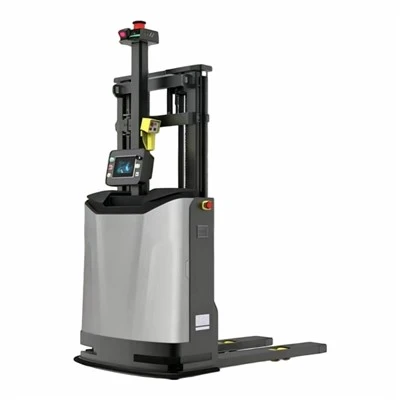
If you’re running a facility that needs to move hundreds or thousands of items a day across a big space, and you’re tired of forklift accidents, tired of workers walking 10 miles a day, or tired of orders taking too long to ship, we can help. We’ll come to your site, take the time to walk your floors, listen to your pain points, and build a custom AMR fleet that works for your space, not against it. Reach out to us to talk through your needs—no sales pitch, just real talk about what will actually make your operations smoother.
Automated Guided Vehicle References:
- Welch, G., & Fox, D. (2016). Simultaneous Localization and Mapping: Part I. Foundations and Trends in Robotics.
- Bares, J. E., & Werfel, J. (2019). Large-Scale Autonomous Mobile Robot Fleets for Industrial Logistics. Journal of Field Robotics.
- Li, X., et al. (2022). Fusion of LiDAR, Camera, and GNSS for Outdoor Autonomous Robot Localization in Challenging Environments. IEEE Robotics and Automation Letters.
- International Federation of Robotics. (2023). Industrial Autonomous Mobile Robot Deployment Trends for Large-Scale Facilities. World Robotics Report.
Shenzhen Ginnee Intelligent Warehousing Robotics Co., Ltd.
As one of the most professional autonomous mobile robot suppliers in China, we’re featured by quality products and low price. Please rest assured to wholesale durable autonomous mobile robot in stock here and get quotation from our factory. We also accept customized orders.
Address: Room101, No.162 JunXin Road, Niuhu Community, Guanlan Strect, Longhua District, Shenzhen, Guangdong Province, China.
E-mail: huangyongmei@szginnee.com
WebSite: https://www.ginneerobotics.com/
