As an embroidery beads supplier that’s worked with bridal designers and dressmakers for over a decade, I’ve watched countless brides go from envisioning a soft, understated gown to walking down the aisle in a piece that feels like a reflection of their personality—all because of the right beads. Choosing beads for a wedding dress isn’t just about picking pretty ones; it’s about balancing light, movement, durability, and personal style, while making sure every bead stays secured through hours of dancing, hugging, and saying “I do.” After helping clients source beads for everything from simple elopement gowns to couture ballgowns with 10,000+ individual beads, here’s the breakdown of what I always walk brides and designers through. Embroidery Beads
First, let’s talk about the core job of wedding dress beads: they need to perform as much as they look good. Unlike a casual tote bag or a throw pillow, a wedding dress is worn for 12+ hours, often through outdoor heat, indoor dancing, and casual mishaps (think a drink spill, a hug from a distant relative, or a quick dive to fix a train). I’ve seen too many gowns ruined because beads were too lightweight, too fragile, or not secured with the right thread, so performance should come before aesthetics.
Let’s start with bead type, because this is where a lot of first-time buyers get confused. The three most common options for wedding dresses are glass beads, crystal beads, and seed beads—and each has a very different role. Glass beads are the workhorses of bridal embroidery. They’re durable, come in a huge range of sizes, shapes, and finishes, and are far more affordable than crystal, making them perfect for filling in large areas or for brides on a budget. I recommend glass beads for things like beaded bodices where weight distribution matters—too many heavy crystals can pull a gown’s structure out of shape over time. The key here is to look for “high-quality glass” beads, not the cheap ones you find at craft stores; cheap glass has rough edges that can fray your embroidery thread and don’t catch light evenly.
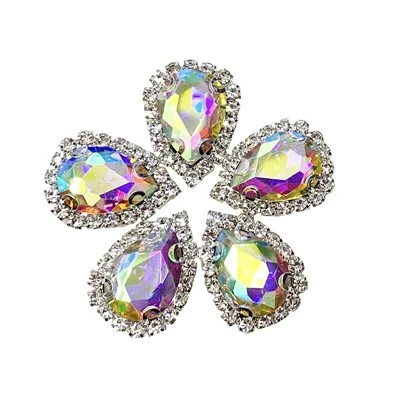
Crystals, on the other hand, are the showstoppers. If a bride wants that classic, sparkling wedding glow that looks like starlight, crystals are the way to go. Swarovski is the gold standard for bridal, but I also work with a lot of lesser-known crystal suppliers that offer a similar cut at a lower price point for brides who don’t want to splurge on brand name. What makes crystals different from glass is their faceting—each cut is designed to reflect light from multiple angles, so even in dim church lighting or under string lights at a reception, they’ll catch every movement. The downside? Crystals are heavier, so you don’t want to overuse them. A mix of small crystal rondelles along a neckline, paired with glass seed beads for filling in, gives you the sparkle of crystals without weighing the gown down. I always warn clients not to use large, chunky crystals for long train embroidery—they’ll pull the train and make it harder to walk.
Seed beads are the tiny, uniform beads that form the base of most bridal embroidery. They’re super small, so they’re perfect for creating delicate patterns like lace, floral motifs, or subtle gradients. They come in different hole sizes too—look for seed beads with large holes for easier threading, especially if you’re working on a large gown. Seed beads are also great for texture: mixing matte seed beads with slightly shiny ones adds depth without being too flashy. I’ve seen brides use matte seed beads for a bohemian wedding dress, paired with small crystal beads for a focal point, and that combination feels so natural, not overdone.
Next, color. This is where I see the most mistakes, especially with brides who think “white is white” when it comes to beads. There’s a huge difference between off-white, ivory, cream, and even blush beads, and matching them to your dress’s fabric is non-negotiable. If your dress is pure bright white satin, go for white or frosted white beads—ivory beads will make your dress look yellow in photos. But if your dress is ivory tulle or lace, ivory or cream beads are the way to go; white beads will look harsh and out of place. A lot of people forget that different fabrics change color in different lighting too: a lace dress with a soft yellow undertone will look different in natural sunlight vs. warm indoor wedding lighting, so I always bring sample beads to clients to hold up against their actual dress fabric before they order. For brides who want a subtle pop, blush or champagne beads work on ivory gowns—they add a soft warmth without being too bold, especially for spring or summer weddings.
Size matters too, and it’s not just about what looks good—it’s about function. For necklines and bodices, where you want to draw attention to your face and upper body, mix sizes: small 2mm beads for filling in, 4mm beads for focal points, and maybe a single 6mm bead as a center accent. That mix gives dimension without looking cluttered. For skirts and trains, stick to smaller beads, because large beads will catch on things like door handles, chairs, or your partner’s suit lapels. I once had a client whose gown had 8mm crystal beads on the train, and during the rehearsal dinner, a waiter’s tray snagged one and pulled a whole section of embroidery off—she had to rush to a seamstress to fix it before the wedding. That’s a story I tell every client to remind them that train embroidery needs to be as durable as it is pretty.
Finish is another detail that most brides overlook, but it can make or break a gown’s vibe. For a classic, elegant wedding, a satin or iridescent finish works perfectly—iridescent beads shift from white to soft pink or blue in light, which feels romantic without being too loud. For a modern, minimalist wedding, matte or metallic finishes (like gold or silver) are great—gold adds warmth to ivory gowns, silver is crisp for white gowns. For a bohemian or rustic wedding, I recommend a rustic or vintage finish—beads that look slightly aged, with a soft, worn texture, pair perfectly with lace or natural silk fabrics. Avoid shiny, high-gloss finishes if you’re going for a subtle look; they’ll catch too much light in photos and make the gown look overwhelming.
Now, let’s talk about something that’s just as important as choosing the right beads: quantity and placement. A lot of brides think “more beads = more sparkles,” but that’s not true. Too many beads can make a gown feel heavy, hot, and uncomfortable to wear for 12 hours. I usually calculate quantity based on the area being beaded: a simple bodice might need 5,000 to 10,000 beads, while a full ballgown with beaded bodice, skirt, and train might need 50,000 to 100,000. The key is to distribute the weight evenly. If you have a heavy beaded panel on one side of the bodice, the other side needs the same number and size of beads to keep the gown balanced. For placement, focal points (neckline, waist, shoulders) should have more beads, while less visible areas (the back of the train, the inner lining) can have fewer. That way, you get the most impact where it matters, without wasting beads or making the gown too heavy.
Durability is the final, non-negotiable factor. As an embroidery beads supplier, I test every bead we sell by pulling it gently to make sure it doesn’t chip or crack, and checking that the holes are smooth so they don’t fray thread. Cheap beads can crack during embroidery, which leaves sharp edges that can snag on fabric or skin. I also recommend using beading thread specifically made for wedding dresses—nylon thread is strong and flexible, while polyester thread is more durable for heavy beads. Never use regular sewing thread; it can break easily, especially if it gets caught on something. Another tip: for any beads that are going to be in high-movement areas (like the hem of the train or the sides of the bodice), add a small dot of fabric glue to the knot after securing the bead. That extra step keeps beads from falling off during the wedding.
I’ve worked with brides who come to me with a vague idea of what they want—sometimes just a photo of a gown they love, sometimes a Pinterest board full of sparkles—and I help them narrow down their choices every time. The best part of my job is seeing a bride try on her gown for the first time and tell me that the beads feel “her”—not too much, not too little, just right. Whether she’s going for a classic ballgown with Swarovski crystals, a simple slip dress with delicate seed bead embroidery, or a bohemian lace gown with a mix of matte and iridescent beads, I make sure the beads are perfect for her day.

If you’re a bride, a dressmaker, or a designer working on a wedding gown and need help choosing the right embroidery beads—whether you’re on a budget, working on a couture piece, or looking for something specific—reach out to discuss your needs. I can send you sample beads to match your fabric, help you calculate the right quantity, and make sure you get the perfect beads that balance beauty, durability, and your vision for your big day.
Glass Beads References
- Bridal Fashion Industry Association. (2022). Crafting the Modern Wedding Gown: Materials and Techniques for Longevity.
- Textile Institute. (2021. Beadwork in Couture Embroidery: A Guide to Selection and Application.
- The Embroiderer’s Guild of America. (2020. Choosing Beads for Bridal Wear: A Guide to Light, Weight, and Aesthetic Balance.
Hubei Jingcan Glass Products Co., Ltd.
Hubei Jingcan Glass Products Co., Ltd. is well-known as one of the leading embroidery beads manufacturers and suppliers in China. Please feel free to wholesale bulk high quality embroidery beads for sale here from our factory. We also accept customized orders.
Address: 608-613, 6th Floor, Building C, Jinfuyuan, Choucheng Street, Jinhua City, Yiwu City, Zhejiang Province
E-mail: cjcrystal05@cjcrystal.cn
WebSite: https://www.go2cjbeads.com/
