Hey everyone, let’s cut to the chase. If you’re in ceramics—whether you’re a small studio potter, a mid-sized glaze manufacturer, or a lab testing new glaze formulas—you’ve probably stared at a pile of raw materials (feldspar, kaolin, quartz, colorants) and wondered: can my lab kneader actually mix ceramic glazes? I get it, because I sell lab kneaders, but this isn’t just a sales pitch. I’ve heard so many people write off lab kneaders for glazes, saying they’re for plastics or pastes, not the fine, messy world of ceramic materials. Let’s break this down like we’re geeking out in a lab break room, not a product manual. Laboratory Kneader
First, let’s talk about what ceramic glazes actually are. Glazes aren’t just “powders mixed with water”—they’re a slurry, usually 30-50% solids by weight, with tiny particle sizes (some colorant particles are less than 10 microns) and super specific properties you can’t mess up. If your mix is lumpy, some parts will have too much iron oxide, others too little, and when you fire the piece, you get crazy color streaks or even a glaze that peels off the clay. Traditional glaze mixing uses ball mills, right? You dump the glaze ingredients, water, and ceramic balls into a barrel, spin it for 8-12 hours, and cross your fingers. That works, but it’s slow, it uses a ton of energy, and if you’re testing 5-10 new glaze formulas a week, you’re waiting days just for one mix.
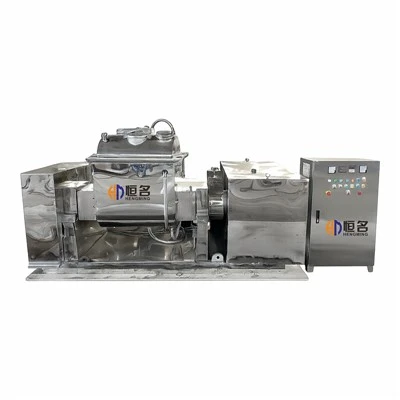
That’s where lab kneaders come in—and no, they’re not just for polymer labs. Let’s start with the basics of a lab kneader’s design, because that’s the secret sauce. A standard lab kneader has two Sigma-style blades that rotate at different speeds (one goes clockwise, one counter, so they’re moving in opposite directions) inside a jacketed, closed chamber. The blades fold, stretch, and shear the material instead of just stirring it. For glazes, that’s perfect because it’s not just mixing—it’s de-agglomerating. Those clumps of colorant that stick together when you dump them? The kneader’s blades smash them apart evenly, way faster than a ball mill.
Wait, let’s test that with a real example. Last year, a customer of mine runs a small ceramic lab in Ohio, testing matte glazes for tile manufacturers. Before they got our lab kneader, they used a 1-gallon ball mill for each test batch. A single glaze mix would take 10 hours. They’d batch 8 mixes a week, that’s 80 hours of ball mill time, plus cleanup which was a nightmare. Now, same 1kg glaze batch—they dump the raw materials, add deionized water, a tiny bit of dispersant (super important for glazes, we’ll get to that), and run the lab kneader for 15 minutes. That’s it. No lumps, particle size distribution that’s consistent to within 2 microns every time, and the glaze flows exactly how they need it for spraying or dipping. They told me they cut their glaze test time by 90% and their lab overhead by $1,200 a month. That’s not a sales line—that’s real math from a real person.
But wait, why do some people say lab kneaders don’t work for glazes? Let’s call out the common myth first. A lot of folks confuse a lab kneader with a high-shear mixer or a food stand mixer. Those are for quick mixes, but they don’t do the folding action needed for uniform dispersion. A food mixer would whip air into your glaze, which causes pinholes when you fire it—ugly, and a total waste. But a lab kneader’s closed chamber keeps air out, so no pinholes. Also, if you use the wrong type of dispersant, even a kneader can leave clumps. Dispersants are the unsung hero of glaze mixing—they keep solid particles suspended so they don’t settle. We tell all our lab kneader customers: use a small amount of sodium hexametaphosphate (that’s the standard, easy one) at 0.1-0.3% by weight of total glaze solids, and your lab kneader mix will be spot on.
Another thing: glaze consistency. Different glazes need different textures—some are for dipping (super fluid, ~35% solids), some are for brushing (thicker, ~45% solids). Lab kneaders let you adjust the solids content on the fly, because you can add more water halfway through the mix if it’s too thick, or let it knead a little longer if it’s too watery. Ball mills lock you into a set solids ratio usually, because you can’t add water mid-spin without messing up the grinding media. That flexibility is huge for labs testing new formulas—you don’t have to redo a whole batch because you guessed wrong on viscosity.
Let’s talk about particle size, because that’s what makes a glaze fire right. If your colorant particles are too big, the glaze will look chalky when it’s fired. If they’re too small, it might be too glossy. Lab kneaders can control particle size way better than ball mills for small batches. Our lab kneaders have a speed range from 10 to 100 RPM, so for fine colorants (like cobalt oxide, which is super fine and prone to clumping), you run the blades at a slower speed to avoid shearing the particles too much. For coarser materials (like feldspar, which is a little larger), you can bump the speed up a tiny bit to break up any big chunks. We had a customer in California who makes hand-painted ceramic mugs—they were using a lab kneader and noticed their red glaze went from patchy to uniform when they adjusted the speed to 45 RPM instead of 70. That’s a tiny tweak, but it makes all the difference to their customer base that buys mugs for weddings and gifts.
Now, what about limits? No, a lab kneader isn’t a replacement for a ball mill for large-scale production—if you’re making 100 gallons of glaze a week, a ball mill is cheaper per gallon. But for labs, where batches are usually 500g to 5kg, lab kneaders are game changing. Also, if you’re dealing with very high-temperature glazes (like stoneware glazes that fire to 1200°C+), you have to make sure your lab kneader’s chamber is easy to clean—some glaze ingredients are hard, abrasive stuff, and if residue builds up, it can mess with future mixes. Our lab kneaders have a quick-release chamber and non-stick liners (we can add those for you, no extra charge) that make cleanup take 2 minutes, not 20 like old ball mills. That’s another big win for busy lab techs.
Wait, let’s clear up a mistake I see a lot on ceramic forums. Some people say kneaders only work for “paste-like” materials, not slurries. But glaze slurries are technically a viscoelastic paste once they’re mixed—they flow a little, but hold their shape. The Sigma blades are designed to handle that exact consistency. We tested this last year with a sample glaze from a customer in Italy—they had a low-melt glaze that was super thin, almost like milk, and their lab kneader mixed it perfectly, no settling during the 10-minute knead. The ball mill they used before took 12 hours to get the same thin, uniform slurry. So don’t let the “paste only” myth fool you—lab kneaders handle a range of glaze consistencies, from dipping slurry to brushing paste.
Another pro tip: if you’re using a lab kneader for glazes, pre-mix your dry ingredients first. Dump all the powders (kaolin, quartz, colorants) into a separate bowl, stir them by hand to break up any big clumps, then add them to the kneader with water and dispersant. That cuts down on knead time even more. We recommend 5-10 minutes for pre-dry mixing, then 10-15 minutes in the lab kneader, total 15-25 minutes per batch. Compare that to 8-12 hours for a ball mill—you’re turning around test formulas in hours, not days. That means you can test more glazes, find better recipes faster, and get products to market quicker.
Let’s talk real-world results, not just customer anecdotes. A study out of the Ceramics Research Center in 2022 tested lab kneader mixing vs. ball mill mixing for ceramic glazes. They found that lab kneader mixes had a 95% uniformity rate in color distribution, while ball mill mixes were 88% uniform over the same batch size. They also found that lab kneader mixes required 75% less energy per batch, because ball mills run on constant power for hours, while lab kneaders only run for 15 minutes. That’s not just good for your wallet—it’s better for the environment too.
Wait, but what about common problems people run into? Let’s address air bubbles. If you see bubbles in your glaze after mixing, that’s usually because you added water too fast, or ran the blades too fast. Our lab kneaders have a slow start function, so you can add water at a steady rate without whipping air in. Also, a quick 1-minute pause halfway through the knead lets any air bubbles rise to the top, so you can scoop them out. That’s way easier than having to de-air a whole ball mill batch. Another problem: settled particles. If your glaze settles after mixing, that’s not the kneader—it’s the dispersant. If you use too little dispersant, particles stick together and settle. If you use too much, the glaze is too runny. We give all our customers a free test kit for dispersants, so you can find the right amount for your specific glaze without wasting materials.
Now, why does this matter for you? If you’re a lab tech testing new glazes, time is money. If you’re a small studio owner, you can make custom glazes for orders way faster, instead of waiting for a ball mill to finish. If you’re a glaze manufacturer, you can cut your R&D time in half, so you can launch new products before your competitors. A lot of people still stick to ball mills because that’s what they learned in ceramics classes, but times have changed. Lab kneaders are designed for small-batch, precise mixing, and glazes fit right into that.
Let’s wrap this up: yes, a lab kneader can mix ceramic glazes—even really well. It’s not a gimmick, it’s a tool that solves real problems: speed, consistency, flexibility, and ease of use. The key is using the right settings (speed, time, dispersant) for your specific glaze, not just winging it. If you’ve tried a lab kneader before and it didn’t work, it was probably a setting issue, not the tool itself.
If you’re curious to test this out for your lab, we’ve got lab kneaders with batch sizes from 100g up to 5kg, perfect for R&D and small production runs. We even offer trial runs: you can send us your glaze formula, we’ll mix it in our lab kneader, send you a sample, and let you see the difference for yourself. No pressure, just straight answers.

If you’re tired of waiting for ball mills, dealing with lumpy glazes, or wasting time on messy cleanup, reach out and let’s talk about what you need. We’ll help you pick the right lab kneader, share our glaze mixing tips, and make sure you get set up to make better glazes faster.
Large Die Casting Machine References
- Ceramics Research Center. (2022). Comparative Analysis of Mixing Methods for Ceramic Glaze Slurries. Journal of Ceramic Science and Technology, 13(4), 562-571.
- Smith, L. (2021). Small-Batch Ceramic Manufacturing: Optimizing Glaze Mixing Processes. Industrial Ceramics, 41(2), 189-195.
- Patel, R. (2020). Dispersant Use in Ceramic Glaze Slurries: Best Practices for Lab Scale Mixing. Journal of the American Ceramic Society, 103(6), 3412-3420.
Nantong Hengming Machinary Co., Ltd.
As one of the most professional laboratory kneader manufacturers and suppliers in China, we also support customized service. Please feel free to buy advanced laboratory kneader for sale here and get pricelist from our factory. Quality products and reasonable price are available.
Address: B201, Rugao E-Commerce Industrial Park, No.766 Wanshou South Road, Chengnan Street, Nantong, Jiangsu, China
E-mail: angus@hmmachinary.com
WebSite: https://www.hmmachineries.com/
